

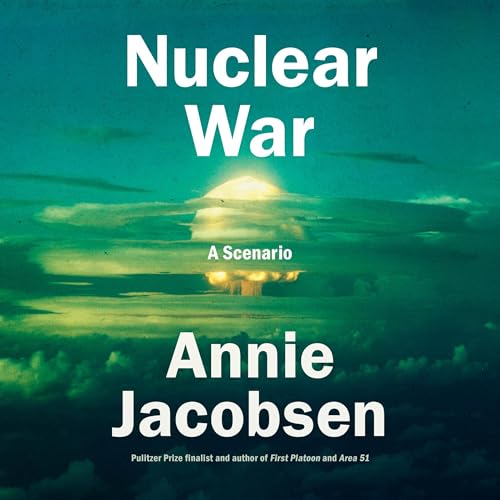
Nuclear War
A Scenario
Impossible d'ajouter des articles
Désolé, nous ne sommes pas en mesure d'ajouter l'article car votre panier est déjà plein.
Veuillez réessayer plus tard
Veuillez réessayer plus tard
Échec de l’élimination de la liste d'envies.
Veuillez réessayer plus tard
Impossible de suivre le podcast
Impossible de ne plus suivre le podcast
3 mois d'Audible Standard gratuits
3 mois pour 0,00 €/mois, puis 5,99 €/mois. Possibilité de résilier chaque mois.
L'offre prend fin le 15 Juillet 2026 à 23 h 59.

Nuclear War
Lu par :
Annie Jacobsen
Acheter pour 17,99 €
-
Lu par :
-
Annie Jacobsen
-
De :
-
Annie Jacobsen
Instant Los Angeles Times bestseller
Finalist, Dayton Literary Peace Prize
One of NPR's Books We Love
One of Newsweek Staffers' Favorite Books of the Year
Shortlisted for the Baillie Gifford Prize
“In Nuclear War: A Scenario, Annie Jacobsen gives us a vivid picture of what could happen if our nuclear guardians fail…Terrifying.”—Wall Street Journal
There is only one scenario other than an asteroid strike that could end the world as we know it in a matter of hours: nuclear war. And one of the triggers for that war would be a nuclear missile inbound toward the United States.
Every generation, a journalist has looked deep into the heart of the nuclear military establishment: the technologies, the safeguards, the plans, and the risks. These investigations are vital to how we understand the world we really live in—where one nuclear missile will beget one in return, and where the choreography of the world’s end requires massive decisions made on seconds’ notice with information that is only as good as the intelligence we have.
Pulitzer Prize finalist Annie Jacobsen’s Nuclear War: A Scenario explores this ticking-clock scenario, based on dozens of exclusive new interviews with military and civilian experts who have built the weapons, have been privy to the response plans, and have been responsible for those decisions should they have needed to be made. Nuclear War: A Scenario examines the handful of minutes after a nuclear missile launch. It is essential reading, and unlike any other book in its depth and urgency.
adbl_web_anon_alc_button_suppression_t1
Narrative tunnel vision, poor writing
Une erreur s'est produite. Réessayez dans quelques minutes.
Reportedly based on a series of interviews with (retired) experts in the field as well as various public documents, it is written as a very effective thriller. Indeed, some may compare its page-turner qualities to Dan Brown’s novels.
Sadly, however, it is marred by repetitions, often of the exact same phrases a few paragraphs apart and sometimes in meaning within the same utterance such as « no agriculture, no farming, no crops ».
The book’s subtitle, « A Scenario », cleverly prevents any criticism of the book’s plot. Yet, the reader’s suspension of disbelief is at times severely challenged, as when the aircraft carrying away the US President and 13 other persons is only provided with 6 parachutes.
Any non-American reader will be struck by the work’s insularity. Africa is not mentioned once whereas the impact of an attack on the US for Mexico and Canada is barely alluded to. Significant detail is provided however as to how animals in Washington zoo would be left to fend for themselves!
By necessity, the information supporting this book is outdated and partial. The persons interviewed were already retired and could only speak of what they knew while they were at work, and this within the limits of what remains classified.
Worse, a shadow is cast as to how rigorously the information was recorded and synthesized. Specifically, the assertion « Après moi, le Déluge » (« After me, the Flood ») is quoted three times in the book. It is wrongly attributed to Emperor Napoleon rather than to king of France Louis XV. The latter was not cynically referring to the aftermath of any war he may have initiated but rather to his heir, future Louis XVI, whom he did not hold in high esteem and whose reign would indeed end with the French Revolution. This may easily be checked on the Internet with a few clicks.
This alarmist work may well contribute to the return of a heightened awareness of the dangers linked to nuclear war. Less sensationalism would perhaps have done a more convincing job.
Mixed Feelings!
Une erreur s'est produite. Réessayez dans quelques minutes.
Tone and rhythm are horrible
Une erreur s'est produite. Réessayez dans quelques minutes.


